

The SS Daisy Legal History Committee is a committee of the Law Society of Newfoundland and Labrador whose mandate is the preservation of Newfoundland and Labrador’s legal heritage, including the history of law, the courts, the lawyers and the Law Society. The name of the committee is taken from the government boat SS Daisy that carried lawyers, judges, sheriffs and clerks to the courts in smaller communities in pre-1949 Newfoundland.
The SS Daisy Legal History Committee works to date include taping and transcribing oral histories of senior members of the Bench and Bar, preserving the Barrister’s Roll which dates from 1826, and publishing the last volume of the Newfoundland Law Reports.
*At this time, we cannot ship to the United States*
Showing 17–20 of 25 results
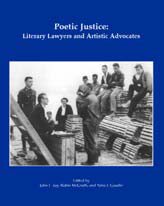
It has often been said that the law is a jealous mistress, who demands of those who would succeed in it an earnest and entire devotion. The poet Emerson, however, makes the same claim for art, and admonishes that if a man has a genius for painting, poetry or music he makes an ill provider. This small anthology puts the lie to both aphorisms. Consider James Boswell, Leon Tolstoy, A.M. Klein, Frank Scott and others. All boast of two mistresses – the law and art. B & W and full colour illustrations throughout.
Add to cart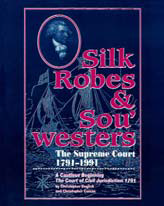
The bicentenary of the establishment of Newfoundland’s supreme “court of civil jurisdiction” marks the emergence of a statutory regime from which the present Judicature Act, court system, jurisdiction, procedures, and officers have evolved. In light of the modest material, demographic, institutional and experiential base upon which the Act of 1791 was erected, the process of tailoring and adapting a system of law to new, often unforeseen, demands over 200 years marks a considerable achievement. This essay traces the emergence of the Act of 1791 from earliest times.
Add to cart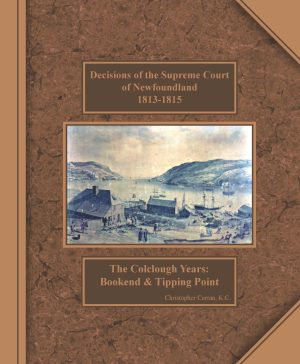
Transcribing the decisions of the Supreme Court of Newfoundland, volume III covers the years 1813-1815, when Caesar Colclough was Chief Justice. The book focusses on his judicial output and assesses it within the context of his predecessors in office, during a time of significant economic change in St. John’s and Newfoundland.
Add to cart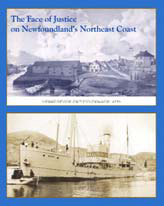
The essays contained in this volume trace essential elements of the face of justice on Newfoundland’s northeast coast from the migratory fishery of the 18th century to the pre-confederation decades of the 20th. They were written by academic and by public community historians and reflect the growing interest in our legal history both within and outside the university community. They show not only that the sources of law and the level of justice activities varied as demographic, social and economic conditions changed throughout this period, but that the law and its institutions formed an integral part of the fabric of everyday community life and were valued as such.
Add to cart